BEE Elements

BEE Elements · The Platform

_Processes, tools, costs.
How much? Which? Where?
Your organization’s brain.
Under control.

The AI auditor talks to your team and builds a living catalog of processes, procedures and tools, with costs and dependencies, in one place.

For leaders and heads of operations who want to see what costs how much, which tools and in which processes.

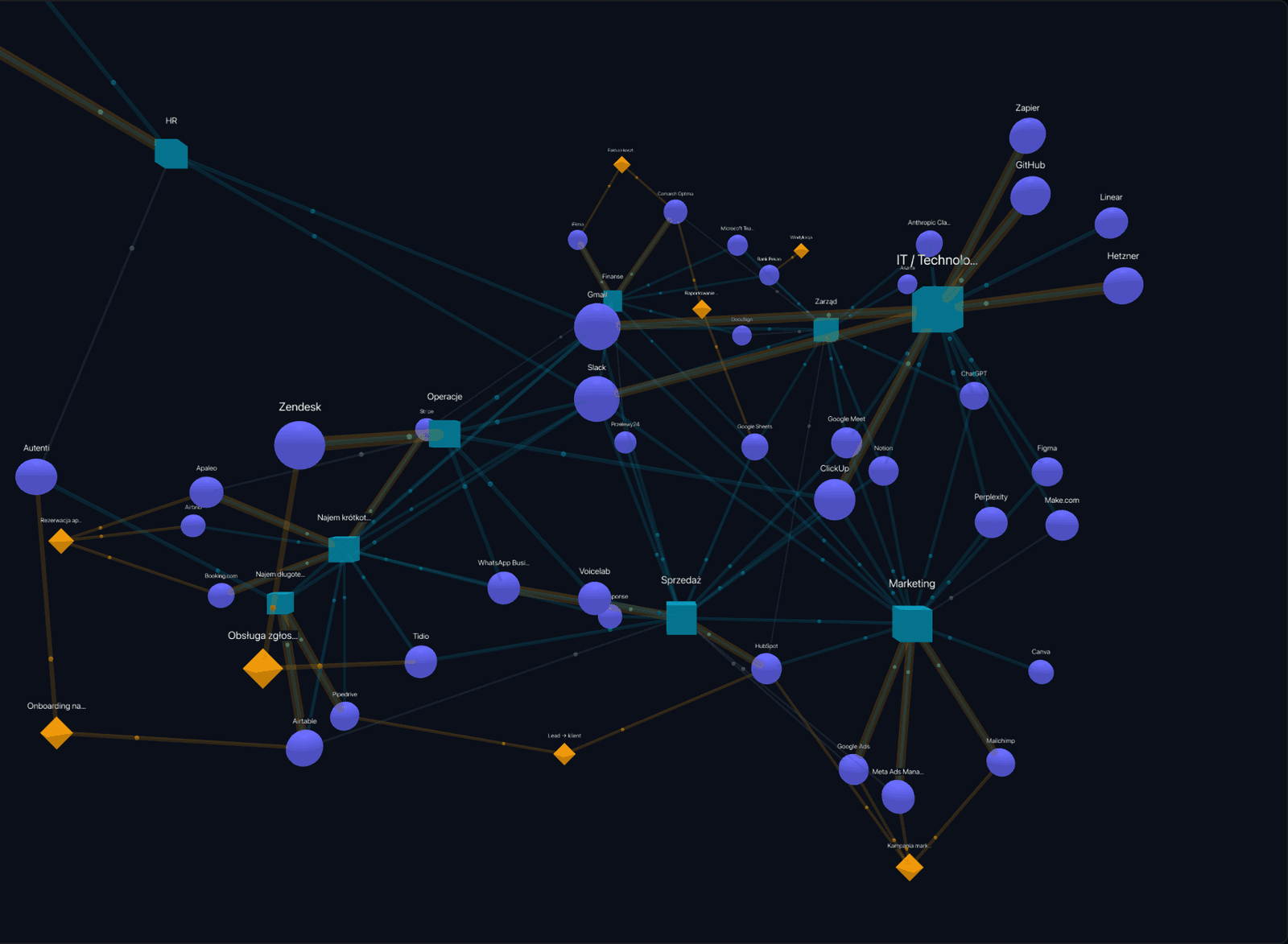
The Platform on a tablet: a catalog of tools with a graph of dependencies between tools, departments and processes
Demo environment, fictional data.

You run a company nobody has ever shown you in full.

Processes live in spreadsheets, Slack threads and people’s heads. Tools buy themselves, and you hear about problems when someone hands in their notice. This is operational debt. It grows with every month of growth, and every tool shows only a fragment of it.

  • SaaS management

    Shows: It will show you invoices, SSO logins and the number of licences.

    Misses: It will not show the spreadsheet your sales really run on.

  • Process mining

    Shows: It will read event logs from your ERP and CRM.

    Misses: It will not see a process that lives in Slack, in e-mails and in spreadsheets.

  • Knowledge management

    Shows: It will store everything someone managed to write down.

    Misses: It will not ask anyone about what was never written down.

  • Enterprise architecture

    Shows: It will give you a hand-drawn map of your systems.

    Misses: Outdated on the day it is published.

  • Consulting audit

    Shows: It will give you a six-figure report, ready in 8 weeks.

    Misses: Out of date before you manage to implement it.

The shared blind spot: your people.

They know how the company really works. None of these tools asks them.

The Platform asks and remembers. Every answer goes into the living catalog.

Three steps from chaos to full visibility.

We do not send surveys nobody fills in. The AI auditor talks to your people, and you get a picture of the company nobody had before you.

  1. 01

    A conversation, not an interrogation

    The AI auditor interviews every employee: about tools, processes and workarounds nobody asked about before. It adapts its tone to the person, and anonymisation is on by default.

  2. 02

    Data, not impressions

    Every “it is fine here” gets a follow-up question. Every finding goes into the catalog as a hard record: tool, cost, integrations, risk.

  3. 03

    A catalog, not a report

    Instead of a PDF that ages in a drawer, you get a living map of the company: processes, departments, tools and costs. You ask in natural language, and the answer comes from the data.

The audit maps the process, it does not judge the person.

An employee can report a workaround without giving their name. This removes the fear of being judged and unlocks knowledge of how the company really works.

One system. The whole organization.

From an employee interview to a board decision. Every module works on the same living catalog.

AI auditor

The heart of the platform. It talks to your people and brings out what no log can see: knowledge in their heads, informal workarounds and tools nobody officially knows about.

  • A staged interview: tools, processes, problems, verification
  • Findings flagged automatically during the conversation
  • Natural-language questions across the whole audit base
  • Results as validated records, not notes
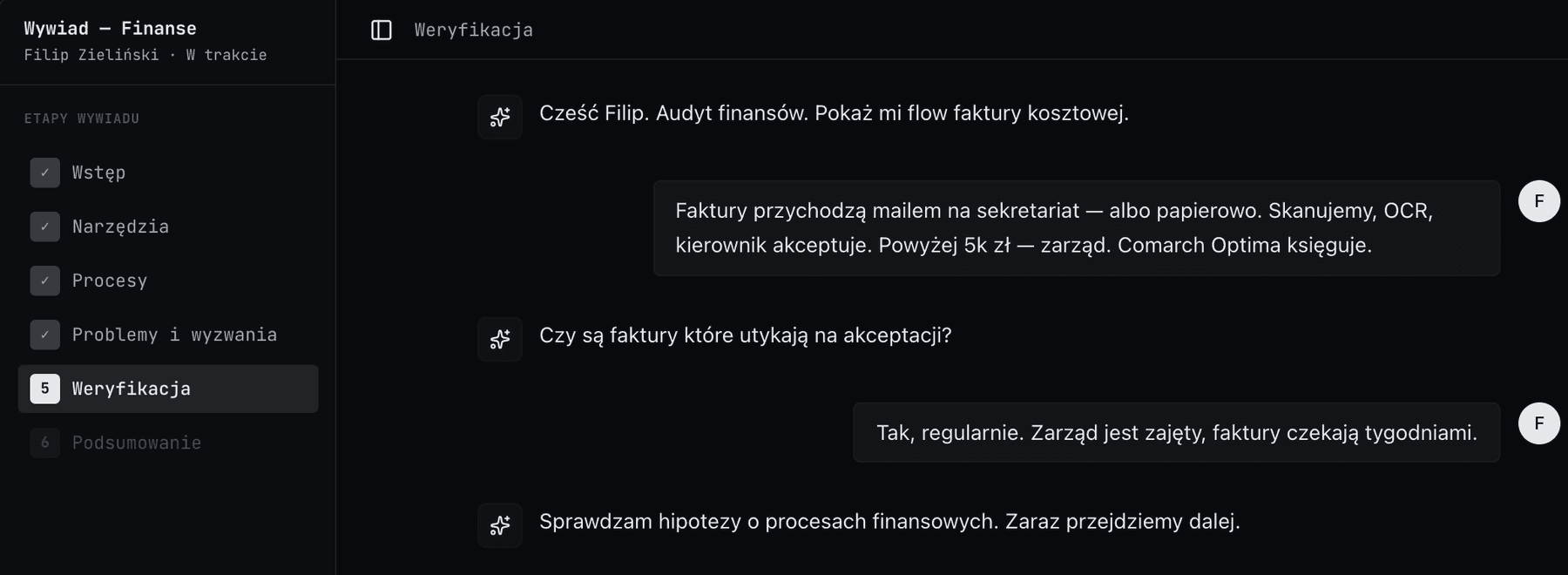
An AI auditor interview in The Platform: interview stages and a conversation about the cost-invoice workflow
Demo environment, fictional data.

Alerts with evidence

Every finding from an interview becomes an alert with a priority, a department and an owner. The evidence is a quote from the conversation, so you know where the problem came from and who reported it.

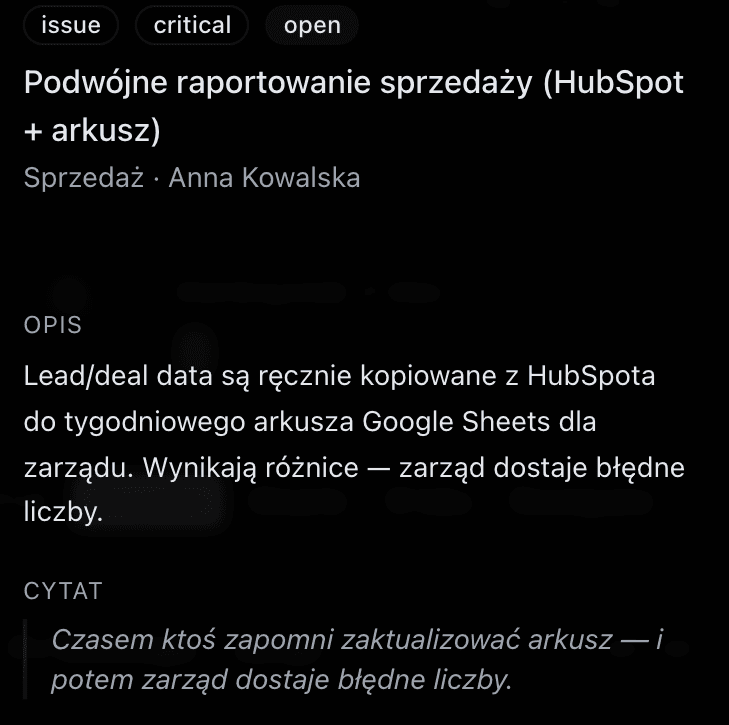
A critical alert in The Platform: duplicated sales reporting, its description and an interview quote as evidence

Living catalog + 3D graph

A catalog of tools with costs, owners and processes. The 3D graph shows the dependencies between tools, departments and processes.

Process mapping

Process diagrams linked to the real tools and departments in the catalog.

Governance and roles

Departments, roles and an approval queue for changes in the catalog. Control without policing.

Knowledge base

Search across the whole catalog: tools, processes, procedures and documents. It searches by words and by meaning.

This is what a company you can see in full looks like.

The COO gets visibility instead of intuition. The CFO sees what every tool costs and who it serves. The Head of IT gets governance without policing. The same catalog, three wins.

You know what will break before it breaks.

Visibility while you scale

A full picture of operations while you can still react.

Your best people’s knowledge stays when they leave.

Knowledge retention

Processes stop living only in people’s heads.

You will find the tools you pay for that nobody uses.

Tool rationalisation

You see the cost of every tool and the departments that use it.

A full operational map of the company.

Operational due diligence

A new COO onboards from a map, not from guesswork.

The one metric we are judged by:

how much operational debt you have actually addressed.

Not the number of interviews. Not the number of reports.

A departmental pilot, not a helicopter view.

We are collecting a list of companies for the first deployments. Each one starts with a single department, not the whole company, and always in the same order: first we map the processes, then we build everything else on top of them.

  1. First

    Process mapping

    The AI auditor talks to the team of one department and maps how its processes really work. This is the foundation: without a process map, nothing else has anything to stand on.

  2. Then

    Catalog of tools and costs

    We layer tools, costs and owners onto the mapped processes. You see what works in which process and what it costs.

  3. Based on that

    Alerts and decisions

    Discrepancies and risks become alerts with evidence from the conversation. Only then do you decide what to change and whether to move on to other departments.

We agree the scope, schedule and terms individually with each company on the list.

Questions before the demo

Where does a deployment start?

With process mapping in one department. On top of the mapped processes we build the catalog of tools and costs, and then the alerts.

Do employees have to fill in surveys?

No. The AI auditor holds a conversation with them and asks follow-up questions. Anonymisation is on by default, and an employee can report a workaround without giving their name.

Can I see the product before deciding?

Yes. In the demo we work in a demo environment: a fictional holding, real mechanics. Interviews, the dependency graph, alerts with evidence and the cost catalog.

How much does it cost?

We agree the scope, schedule and terms individually with each company on the first-deployments list.

You do not have to take our word for it.

See the living catalog in a demo environment: a fictional holding, real mechanics. Interviews, the dependency graph, alerts with evidence and the cost catalog.

or write to: kontakt@beelements.pl

Service provider

The Platform is a product of BEE Elements.

DIGIT OWL Krzysztof Syrek
ul. Śląska 51/6A, 70-430 Szczecin, Poland
NIP: 9552090891 · REGON: 320920247
kontakt@beelements.pl